Showing posts with label Whitey's Lindy Hoppers. Show all posts

Sunday, December 9, 2012

Swingin' with Frankie

In the book Frankie Manning – Ambassador of Lindy Hop I came across the titles of many swing tunes, some of which I had never heard before. In honor of Frankie, and as a way of celebrating my 20th Swing Mix on 8tracks.com I decided to make a mix of 8 tunes that Frankie used to dance to. Follow the link Swing Mix #20 or press play on the Swing Mix #20 player on the right side of this blog.  
Below, in book (not track) order, are the excerpts in which the songs (in bold) are mentioned and some YouTube videos with songs that are mentioned but do not appear in my mix.

#1 Savoy Lindy hoppers liked dancing to fast tunes (like Chick Webb’s “Clap Hands! Here Come Charley,” flag wavers as he called them, which meant crowd pleasers), but not all the time, so orchestras didn’t play fast numbers all night. Dancers today like doing jam circles to “Sing, Sing, Sing,” but we never jammed to music like that. We didn’t even like “Sing, Sing, Sing.” There was too much drum. I’d dance to a fast tune if it was swinging and I liked it. Otherwise, I’d sit it out. (70)

#2 In late 1934 Frankie Manning and his then partner Hilda Morris got to perform at the Apollo Theater as part of a revue and ended up working with Duke Ellington and his band who were on the bill for that week. Frankie remembers: Now, we used to go see Duke all the time at the Apollo and the Harlem Opera House, and we loved his music, but there wasn’t anything I’d heard that was all that danceable. It was fantastic music, and it was exotic – we used to call it jungle music – but his band just didn’t work for the Lindy hoppers. This was 1934, so it was before he came out with all those swing tunes like “Jack the Bear,” “Cotton Tail,” “In a Mellotone,” and “Take the ‘A’ Train.” I’d been listening to “Black and Tan Fantasy,” “Mood Indigo,” “Sophisticated Lady,” and all this other beautiful music, but nothing that was swinging. Finally, Ellington said, “We have a tune called ‘Stompy Jones.’ Would you like to hear it?” I said, “I’ve never heard of it, but just play it and we’ll dance.” So Hilda and I performed the whole week to “Stompy Jones,” which worked just fine (84)
Here's Ellington's famous "Take the 'A' Train" from the film Reveille with Beverly from 1943:


#3 …the tune we always used in contests was “Christopher Columbus.” But earlier in the evening, Chick [Webb] had played “Down South Camp Meeting,” which is this real swingy tune. If you heard it, you’d dance to it. I had found that I could catch all these little breaks in the music, so I said, “How about ‘Down South Camp Meeting’?” “You got it," he said. “What tempo do you want?” “Something about right here,” I said, snapping my fingers. That little humpbacked man up there on the drums hit off the tempo, and those cats started swinging! (99)
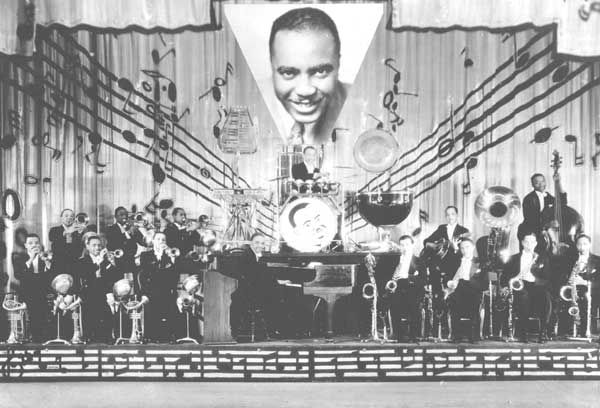
#4 Soon after I introduced the first air step, I was at the Savoy dancing to Jimmie Lunceford’s “Posin’,” either while he was rehearsing in the afternoon or during one of those battle of the bands. As I’ve said, I used to like to catch breaks in the music, and “Posin’”, which he had just come out with, had a nice stop rhythm to it. Each time Willie Smith sang “Evvv-ry-bod-y pose!” and the music stopped, I would freeze my body, then begin dancing again when the band started up after holding for eight counts. Nobody else was doing that, but I did it with my partner because I was so in tune with the music” (103).

#5 In March 1936, we had a two - or three - week run at the Roxy Theater, the first time there for a group of Whitey’s dancers….Around this time, truckin’ was the new vogue, and everybody was doing it. A song titled “Truckin’” had recently come out that went something like, “They had to have something new, a dance to do, up here in Harlem – so, someone started truckin’. To truck, your feet shuffle right, left, right, left with the right side of your body leading as you move diagonally forward, and your right hand shakes while your index finger points up in the air. People said truckin’ was a dance, but it was really just one step, like the black bottom or the Suzie-Q. Whitey was always trying to add the latest dances into the Lindy to make it more exciting and more marketable. In order to make a routine for the stage out of any of these movements, you had to put them with other jazz steps or the Lindy hop. We went into the Roxy as truckers, according to the program, but we just mixed it into our Lindy solos, so the audience would say, “Yeah, they truckin’” (114). The version of "Truckin'" I included in my mix is by Duke Ellington with vocals by Ivie Anderson. Fats Waller's version, however, I have to admit is my favorite:


#6 Frankie recalls when he and Whitey’s Lindy hoppers toured with Cab Calloway back in 1937. At Cab’s first rehearsal for the tour…he asked if I had sheet music, which I didn't. Since I was supposed to know what I was doing by then, and every act was supposed to have its own music, I told him I would bring it the next day. That evening, I ran out and bought the music of Benny Goodman’s “Jam Session,” then stayed up all night listening to the record while I followed along. I couldn’t read the notes, but I counted everything out, visualizing the steps I wanted the Lindy hoppers to do. Sometimes I got up and actually did the movements. The next day, I told Cab I wanted so many choruses of thirty-two bars each of this section, so many of that section (I wanted to make the music longer), then jump back to this spot, and finish it out. Cab was laughing because, as I know now, “Jam Session” is in sixteen-bar choruses (130).  

#7 Later that spring I worked with Count Basie for the first time. I had been listening to Chick Webb since I first began going to the Savoy, but by early 1937 some of us were turning into Basie-ites. To me, Basie swung more than any band out there....Nowadays, whenever I hear Basie, it always makes me want to dance. Some of my favorite songs for dancing are "Shiny Stockings" and "Moten Swing." If I want to show off, I use "Jumpin' at the Woodside" or "Every Tub" (132-133). Of "Moten Swing" there are many Basie versions on YouTube. I am guessing this is probably closest to the version that Frankie would have danced to. I wanted to add it to my mix but 8tracks regulations do not allow you to add more than two tracks by each artist. 


#8 "John's Idea" is a very swinging tune by Count Basie that Frankie used initially in order to choreograph his version of the Big Apple routine back in 1937. Frankie says: Whitey asked me to make up a big apple routine for the Lindy hoppers, so I got to work. At first, as I read the letter and tried visualizing the movements, I thought, What the hell is he talking about? Then I began playing some music and actually doing the steps. I used Count Basie's "John's Idea," initially, but then I switched to "One O'Clock Jump" because it was a little slower and more swinging" (143). [see also my post The Big Apple]

Thursday, December 15, 2011

The Big Apple

big apple night club
The dance that eventually became known as the Big Apple is speculated to have been created in the early 1930s by African American youth dancing at the Big Apple Club, which was at the former House of Peace Synagogue on Park Street in Columbia, South Carolina. The synagogue was converted into a black juke joint called the "Big Apple Night Club.” 

In 1936, three white students from the University of South Carolina – Billy Spivey, Donald Davis, and Harold "Goo-Goo" Wiles – heard the music coming from the juke joint as they were driving by. Even though it was very usual for whites to go into a black club, the three asked the club's owner, Frank "Fat Sam" Boyd, if they could enter. Skip Davis, the son of Donald Davis, said that "Fat Sam" made two conditions: They had to pay twenty five cents each and they had to sit in the balcony. During the next few months, the white students brought more friends to the night club to watch the black dancers. The white students became so fascinated with the dance that, in order to prevent the music from stopping, they would toss coins down to the black dancers below them when the dancers ran out of money. "We had a lot of nickels with us because it took a nickel to play a song. If the music stopped and the people on the floor didn't have any money, we didn't get any more dancing. We had to feed the Nickelodeon", recalls Harold E. Ross, who often visited the club and was 18 years old at the time.

The white dancers eventually called the dance the black dancers did the "Big Apple", after the night club where they first saw it. Ross commented that "We always did the best we could to imitate the steps we saw. But we called it the Little Apple. We didn't feel like we should copy the Big Apple, so we called it that." 
 
Rise in popularity (1937-1938)

During the summer of 1937, the students from the University of South Carolina started dancing the Big Apple at the Pavilion in Myrtle Beach. Betty Wood (née Henderson), a dancer who helped revive the Big Apple in the 1990s, first saw the dance there, and six months later she won a dance contest and become nicknamed "Big Apple Betty." The news of the new dance craze spread to New York, and a New York talent agent, Gay Foster, traveled to the Carolinas to audition dancers for a show at the Roxy Theater, the world's second-largest theater at that time. Eight couples were chosen for the show, including Wood, Spivey, and Davis, to perform the Big Apple during a three-week engagement that began on September 3, 1937. They performed six shows a day to sold-out audiences and greatly contributed to the dance's popularity. After the engagement at the Roxy, the group became known as "Billy Spivey's Big Apple Dancers" and toured the country for six months.


Arthur Murray, a dance instructor and entrepreneur, had two dance studios in New York in 1936. After seeing the Big Apple dancers at the Roxy in September 1937, Murray incorporated the Big Apple into his swing dance syllabus. Due to the popularity of the Big Apple and other popular dances such as the Conga, Murray started to offer franchises in 1937. By 1938, there were franchises in several major cities, including Detroit, Cleveland, Atlanta, and Minneapolis. The company continued to grow to over 200 Arthur Murray dance studios throughout the world by 2003 [on the Life Magazine photo above Arthur Murray can be seen on a chair at the back calling out the formations]. This is a link to a video on YouTube with the short film The Big Apple with the Arthur Murray "Shag" Dancers where you can see how the original Big Apple probably looked like. Dance arrangement and direction by Arthur Murray himself! It's very interesting and rare and hope nobody removes it. Unfortunately, for some reason I cannot post it in here.

frankie manning in the middle
In the fall of 1937, four couples from Whitey's Lindy Hoppers, a Lindy Hop performance group based at the Savoy Ballroom in Harlem, New York, traveled to Hollywood, California, to perform a Lindy Hop sequence for a Judy Garland movie called Everybody Sings. Soon after arriving in California, Herbert "Whitey" White, the manager for the group, sent a telegram to Frankie Manning, the lead dancer for the group, about the new dance craze in New York City called the Big Apple. Manning had never seen the dance before but based on the description of the dance in the telegram, he choreographed a Big Apple routine for the group. Since the dance was based on combining jazz steps that the Lindy hoppers were already familiar with, such as Truckin', the Suzie-Q, and Boogies, the group quickly learned the new steps. They performed their Big Apple routine for Everybody Sing, but the dance scene was eventually cut due to a dispute between the director and Whitey over the dance group's not receiving a break in the filming schedule. 

Frankie Manning remembers: "Whitey asked me to make up a big apple routine for the Lindy hoppers, so I got to work. At first, as I read the letter and tried visualizing the movements, I thought, What the hell is he talking about? Then I began playing some music and actually doing the steps. I used Count Basie's "John's Idea," initially, but then I switched to "One O'Clock Jump" because it was a little slower and more swinging" (Manning & Millman 143).

This is "John's Idea":


And here's Count Basie & his Orchestra performing "One O'Clock Jump" live for the 1943 film Reveille with Beverly.


When the group returned to Harlem, Manning taught his Big Apple version to other dancers in Whitey's Lindy Hoppers, before ever having seen the version done by the Big Apple dancers at the Roxy. Whitey's Lindy Hoppers would dance the Big Apple mixed with Lindy Hop at the Savoy Ballroom until interest in the dance died out.


Later in 1939, the group performed a Big Apple sequence for the movie Keep Punching, which has been recreated by Lindy hop performance groups since the 1990s. 


[Check out my post entitled "Tranky Doo" for a video from The Spirit Moves documentary that includes the Big Apple routine]. 

Frankie Manning notes: "People think that the big apple in Keep Punching is my original routine, but it's not, although it's similar to what we did in Everybody Sing. Actually, I've never re-created the first version of the big apple exactly, but the majority of the steps from it are still done. They form a solid base for the many different versions I've made over the years" (Manning & Millman 147).

The song heard on Keep Punching was re-recorded by The Solomon Douglas Swingtet and is called "Big Apple Contest". You can find it in their album Swingmatism from 2006.

By the end of 1937, the Big Apple had become a national dance craze.  On December 20, 1937, Life featured the Big Apple in a four-page photo spread and the magazine predicted that 1937 would be remembered as the year of the Big Apple.


The moves of the Big Apple are frequently used in Lindy Hop. This is also used as a warm up before Lindy Hop classes. Note that the moves are very 8-count centered, like tap dance. That is, they almost all start on count 8.

Here's a clip from Judy Pritchett's documentary Dancing the Big Apple 1937: African Americans Inspire a National Craze which explores the Big Apple dance in the context of American history:


Sources: 
1. The text in black comes from Wikipedia: Big Apple (dance) 
2. The text in red comes from Frankie Manning - Ambassador of Lindy Hop by F. Manning & C.R. Millman.
3. The photo of the Big Apple night club I found here: barnesrarte360.blogspot.com 
4. The photo of white youth dancing as well as the Arthur Murray photo and the Life Magazine article photo I found here: http://collegiateshag.com/photos.html
5. The photo with Frankie Manning I found in several places on the internet.
6. The last photo with the title "Lesson 4" I found in pixelnaiad's photostream and it's most probably a spread from one of Arthur Murray's dance instruction manuals.

Friday, November 4, 2011

Frankie Manning [1914-2009]

Frankie Manning (May 26, 1914 – April 27, 2009) was an American dancer, instructor and choreographer. Manning is considered one of the founding fathers of the Lindy Hop.


Early years

Manning was born in Jacksonville, Florida in 1914. He moved to Harlem at the age of 3, with his mother, who was also a dancer. Frankie began dancing as a child, then started attending the early evening dances for older teens at the Rennaissance Ballroom. When he was older he started going to the Savoy, which was for better dancers. He frequented Harlem's Savoy Ballroom in the 1930s, eventually becoming a dancer in the elite and prestigious "Kat's Corner," a corner of the dance floor in which impromptu exhibitions and competitions took place. During a dance contest in 1935, Manning and his partner Frieda Washington performed the first air step (often referred to as an aerial) in a swing dance competition against George "Shorty" Snowden and his partner Big Bea, at the Savoy Ballroom. The air step he performed was a "back to back roll" and was danced while Chick Webb played "Down South Camp Meeting", which was Manning's request after having heard the song earlier in the evening. The airstep went flawlessly to the music and astonished over 2,000 audience members watching.

Career 


In 1935, Herbert White organized the top Savoy Ballroom lindy hop dancers into a professional performance group that was eventually named Whitey's Lindy Hoppers. Manning created the troupe's first ensemble Lindy Hop routines and functioned as the group's de facto choreographer, although without that title. The troupe toured extensively and made several films. While with Whitey's, Manning also danced with Norma Miller, who became known as the Queen of Swing. Whitey's Lindy Hoppers disbanded around WWII when many of the male dancers were drafted. After the war, in 1947, Manning created a small performance group called the Congaroos. When the Congaroos disbanded in 1955, Manning quietly settled into a career with the United States Postal Service.

This is a clip from the 1941 short film Hot Chocolate ("Cottontail") featuring Duke Ellington & Orchestra and also Whitey's Lindy Hoppers. Frankie Manning is the one with the white hat: 


Here's also a YouTube link to a clip from the film Radio City Revels where Whitey's dancers appeared uncredited as Whitey's Hopping Maniacs. Frankie Manning is the one in the plaid shirt. Unfortunately, for some reason I cannot post the video here. Finally, you can check my post Hellzapoppin [1941] for a clip of the celebrated lindy hop sequence with Whitey's Lindy Hoppers.

The Lindy Hop

In 1982, Al Minns, a former member of Whitey's Lindy Hoppers, started to teach Lindy Hop at the Sandra Cameron Dance Center where he introduced a new generation of dancers to the Lindy Hop. Before he died in 1985, he told his students that Manning, another surviving member of Whitey's Lindy Hoppers, also lived in New York City.

In 1986, dancers Erin Stevens and Steven Mitchell contacted Manning and asked him to teach them the Lindy Hop. Manning at first declined, before finally agreeing to meet with them; he was skeptical that a much younger generation would really be interested in swing or Lindy. However, Mitchell and Stevens returned to California and helped to spread Lindy Hop to the West Coast and other areas of the U.S. Thus, the swing revival began. That same year, Lennart Westerlund contacted Manning and invited him to Sweden to work with The Rhythm Hot Shots. Manning traveled to Sweden in 1987 and returned there every year from 1989 onward to teach at the Herräng Dance Camp.

Recent years

Once the swing dance and Lindy Hop revival took hold during the late 1980s, Manning taught Lindy Hop to eager devotees around the world, occasionally appearing with Norma Miller. Sometimes, dance workshops returned him to places he hadn't been in decades. For example, Frankie first visited Melbourne, Australia in 1939 to perform at the Princess Theatre. The swing revival and Melbourne's Swing Patrol, brought him back again in 2002; it was his first visit to Melbourne in 63 years.

At the age of 75, Manning co-choreographed the Broadway musical Black and Blue, for which he received a 1989 Tony Award. In 2000, he was awarded a National Endowment for the Arts National Heritage Fellowship.

Manning's autobiography, Frankie Manning: Ambassador of Lindy Hop, written with co-author Cynthia R. Millman, was published by Temple University Press in May 2007. It contains a collection of stories about the early days of swing dancing, Manning's years performing with Whitey's Lindy Hoppers, his experiences during World War II, and his post-war dance troupe, the Congaroos. The book also recounts his experiences of the revival of swing dancing that began in the mid-1980s, and the two decades following.


In recent years, Manning's annual birthday celebrations have drawn together dancers and instructors from all over the world. His 80th birthday, in 1994, was commemorated by a weekend-long celebration in New York City; his 85th culminated in a sold-out party at New York's Roseland Ballroom, where a pair of his dance shoes were placed in a showcase along with those of dancers such as Fred Astaire. For his 86th birthday, a huge gala was held in Tokyo in his honor, which included workshops taught by the maestro himself; the climax of the festivities featured a live orchestra. Manning drew a huge crowd of Japanese and foreign expatriate swing enthusiasts for this memorable occasion. Dedicated cruises were organized for his 89th and 90th birthdays; for his birthday dances, Manning followed his custom of dancing with one woman for every year of his life, partnering 89 and 90 women, respectively, in succession.

Before his death in April 2009, Manning had been planning to celebrate his 95th birthday in May 2009 in New York City at a special Lindy Hop dance event over Memorial Day weekend. The event, commonly referred to as Frankie Fest or Frankie 95, proceeded without him but in his memory and gathered dancers and instructors from around the world. In anticipation of the event, dance groups from all over the globe posted more than 160 videos to YouTube of local performances of the Shim Sham (a swing line dance long associated with Manning) as well as many videos of a Savoy-style routine choreographed especially for the Frankie 95 celebration by noted swing dancer and Lindy instructor Peter Strom. On Sunday of Frankie 95, attendees attempted to set three Guinness world records in Central Park, including one for the greatest number of people dancing the Shim Sham simultaneously in one place.

Proceeds from the five-day Frankie 95 celebration were used to create a Frankie Manning Foundation.

A resident of Corona, Queens, Manning died in Manhattan on April 27, 2009.

Manning was inducted into the National Museum of Dance C.V. Whitney Hall of Fame in 2009.

[http://en.wikipedia.org/wiki/Frankie_Manning]

 
Related Posts Plugin for WordPress, Blogger...